
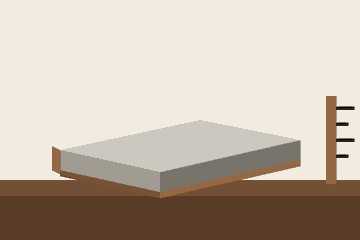
To find how much concrete you need, work out the volume in cubic feet and divide by 27 to get cubic yards. For a slab, that is length (ft) × width (ft) × thickness (in) ÷ 324. A 10 × 10 ft slab that is 4 inches thick holds 33.3 cubic feet, or 1.23 cubic yards. Add 4 to 10 percent for uneven ground and spillage, which is the range given in the National Ready Mixed Concrete Association (NRMCA) ordering guidance as summarised by industry sources. Small jobs under about a cubic yard are usually bags, and larger pours are usually ordered as ready-mix.
To let the math happen for you, use the Concrete Calculator. It works out the volume for slabs, footings, walls, round holes and stairs, and gives bag counts in 40, 50, 60, 80 and 90 lb bags.
Concrete volume formulas by shape
| Shape | Cubic feet | Cubic yards |
|---|---|---|
| Slab, patio, sidewalk or driveway | length (ft) × width (ft) × thickness (in) ÷ 12 | length × width × thickness (in) ÷ 324 |
| Footing, wall or curb | length (ft) × width (ft) × height or depth (ft) | cubic feet ÷ 27 |
| Round post hole or column | about 0.000454 × diameter (in)² × depth (in) | cubic feet ÷ 27 |
| Solid steps (each step a block) | width (ft) × tread (ft) × riser (ft) × (1 + 2 + … + number of steps) | cubic feet ÷ 27 |
The round-hole shortcut is π × radius² × depth with the units already converted to cubic feet. For a longer explanation of the cubic yard conversion, see square feet to cubic yards.
Cubic yards of concrete for common slab sizes
| Slab size | 4 inches thick | 5 inches thick | 6 inches thick |
|---|---|---|---|
| 4 × 4 ft | 0.20 (5.3 ft³) | 0.25 (6.7 ft³) | 0.30 (8.0 ft³) |
| 6 × 6 ft | 0.44 (12.0 ft³) | 0.56 (15.0 ft³) | 0.67 (18.0 ft³) |
| 8 × 8 ft | 0.79 (21.3 ft³) | 0.99 (26.7 ft³) | 1.19 (32.0 ft³) |
| 8 × 10 ft | 0.99 (26.7 ft³) | 1.23 (33.3 ft³) | 1.48 (40.0 ft³) |
| 10 × 10 ft | 1.23 (33.3 ft³) | 1.54 (41.7 ft³) | 1.85 (50.0 ft³) |
| 12 × 12 ft | 1.78 (48.0 ft³) | 2.22 (60.0 ft³) | 2.67 (72.0 ft³) |
| 16 × 16 ft | 3.16 (85.3 ft³) | 3.95 (106.7 ft³) | 4.74 (128.0 ft³) |
| 20 × 20 ft | 4.94 (133.3 ft³) | 6.17 (166.7 ft³) | 7.41 (200.0 ft³) |
| 24 × 24 ft | 7.11 (192.0 ft³) | 8.89 (240.0 ft³) | 10.67 (288.0 ft³) |
Cubic yards, with cubic feet in brackets, before any extra allowance. For what thickness to use, see concrete slab thickness, which covers patios, shed pads, garage floors and driveways.
Concrete for footings
Footing size is set by your local code and soil, so these are example dimensions only. A footing is length × width × depth, all in feet.
| Footing size | Cubic feet per 10 ft run | Cubic yards per 10 ft run |
|---|---|---|
| 12 in wide × 6 in deep | 5.0 | 0.19 |
| 16 in wide × 8 in deep | 8.9 | 0.33 |
| 20 in wide × 10 in deep | 13.9 | 0.51 |
For example, a footing 16 in wide, 8 in deep and 40 ft long is (16 ÷ 12) × (8 ÷ 12) × 40 = 35.56 cubic feet, or 1.32 cubic yards.
Concrete for post holes
Each hole is a cylinder. The table shows the volume of one hole in cubic feet, before subtracting the post itself, which takes up part of the space.
| Hole diameter | 24 in deep | 30 in deep | 36 in deep |
|---|---|---|---|
| 8 in | 0.70 ft³ | 0.87 ft³ | 1.05 ft³ |
| 10 in | 1.09 ft³ | 1.36 ft³ | 1.63 ft³ |
| 12 in | 1.57 ft³ | 1.96 ft³ | 2.35 ft³ |
Multiply by the number of posts, then divide by the bag yield. A 10 in × 24 in hole holds about 1.09 cubic feet, which is 2 bags of 80 lb. For hole sizes by fence height, see how deep should fence posts be.
Concrete for steps
A set of solid concrete steps is a stack of blocks. Each step is as tall as the steps below it plus its own riser. For 3 steps that are 4 ft wide, with 7 in risers and 11 in treads, the volume is 4 × (11 ÷ 12) × (7 ÷ 12) × (1 + 2 + 3) = 12.8 cubic feet, or 0.48 cubic yards. If the steps meet a landing or slab, add that volume separately.
Worked examples
- 12 × 12 ft patio, 4 inches thick: 144 × 4 ÷ 12 = 48 cubic feet, or 1.78 cubic yards.
- 8 × 10 ft shed pad, 4 inches thick: 80 × 4 ÷ 12 = 26.7 cubic feet, or 0.99 cubic yards.
- 12 × 40 ft driveway, 5 inches thick: 480 × 5 ÷ 12 = 200 cubic feet, or 7.41 cubic yards. With 10% extra that is about 8.15 cubic yards.
- 10 fence posts, 10 in × 30 in holes: 10 × 1.36 = 13.6 cubic feet, or 0.50 cubic yards.
- 3 solid steps, 4 ft wide: about 0.48 cubic yards, as above.
How much extra should you order?
NRMCA’s Concrete in Practice 31, Ordering Ready Mixed Concrete, recommends ordering 4 to 10 percent more than the estimate from your plans, according to two industry summaries. The extra covers uneven subgrade, forms that bow and small losses. Running out partway through a pour is worse than having a little left over.
Bags or ready-mix?
A cubic yard is 45 bags of 80 lb, which is 3,600 lb of dry mix to lift, mix and place before it sets (see how many bags of concrete do I need for the bag math and yields). Once a pour reaches about a cubic yard or more, ask a local supplier for a ready-mix quote and compare it with the cost of bags. A cubic yard of mixed concrete weighs about 4,000 lb, which matters for trucks, driveways and hauling; see how much does a yard of concrete weigh.
Ready-mix is sold by the cubic yard. NRMCA’s ordering guidance describes truck mixers holding about 8 to 12 cubic yards, and industry summaries note that the capacity varies by producer, so do not assume every truck holds 10 yards. Ask your supplier about the minimum load, short-load fees for small orders, and how much unloading time is included. Short-load fees and prices vary by supplier and region.
Common mistakes
- Forgetting to convert thickness from inches to feet.
- Using a different thickness for the calculation than for the forms. A nominal 2 × 4 is 3½ inches wide, so it forms a 3½-inch slab unless you dig deeper.
- Ignoring high and low spots in the subgrade.
- Ordering exactly the calculated volume with no allowance.
- Forgetting steps, footings or thickened edges that add to the slab volume.
- Rounding down instead of up.
Common questions
How much concrete do I need for a 10 × 10 slab?
At 4 inches thick, 1.23 cubic yards (33.3 cubic feet). At 6 inches, 1.85 cubic yards. With 10% extra at 4 inches, about 1.36 cubic yards.
How much concrete do I need for a 20 × 20 slab?
At 4 inches thick, 4.94 cubic yards. At 6 inches, 7.41.
How many bags of concrete are in a cubic yard?
About 45 bags of 80 lb, 60 bags of 60 lb, 72 bags of 50 lb or 90 bags of 40 lb, based on QUIKRETE’s Concrete Mix yields. Always use the yield printed on your bag.
How many cubic yards of concrete are in a truck?
NRMCA’s ordering guidance describes truck mixers with a capacity of about 8 to 12 cubic yards. Capacity varies, so confirm with your supplier.
How long before I can use the concrete?
See concrete curing time for how long a new pour needs before you walk or drive on it.
Bottom line
Find the volume in cubic feet, divide by 27 for cubic yards, and add 4 to 10 percent. Use bags for small jobs and ready-mix once a pour reaches about a cubic yard. To work out the volume for slabs, footings, walls, post holes and steps in one place, use the Concrete Calculator. For thickness, bags and curing, see concrete slab thickness, how many bags of concrete do I need and concrete curing time.
Volumes here are planning estimates. Slab thickness, footing size and reinforcement depend on the project, soil and local code, and this guide is not a structural design. Confirm requirements before you pour.
Sources
- QUIKRETE Concrete Mix No. 1101 data sheet (bag yields)
- Calculating Concrete: Ready-mix delivery, minimums and fees (summarises NRMCA Concrete in Practice 31)
- ConcreteSwift: How to order ready-mix concrete (summarises NRMCA ordering guidance)