
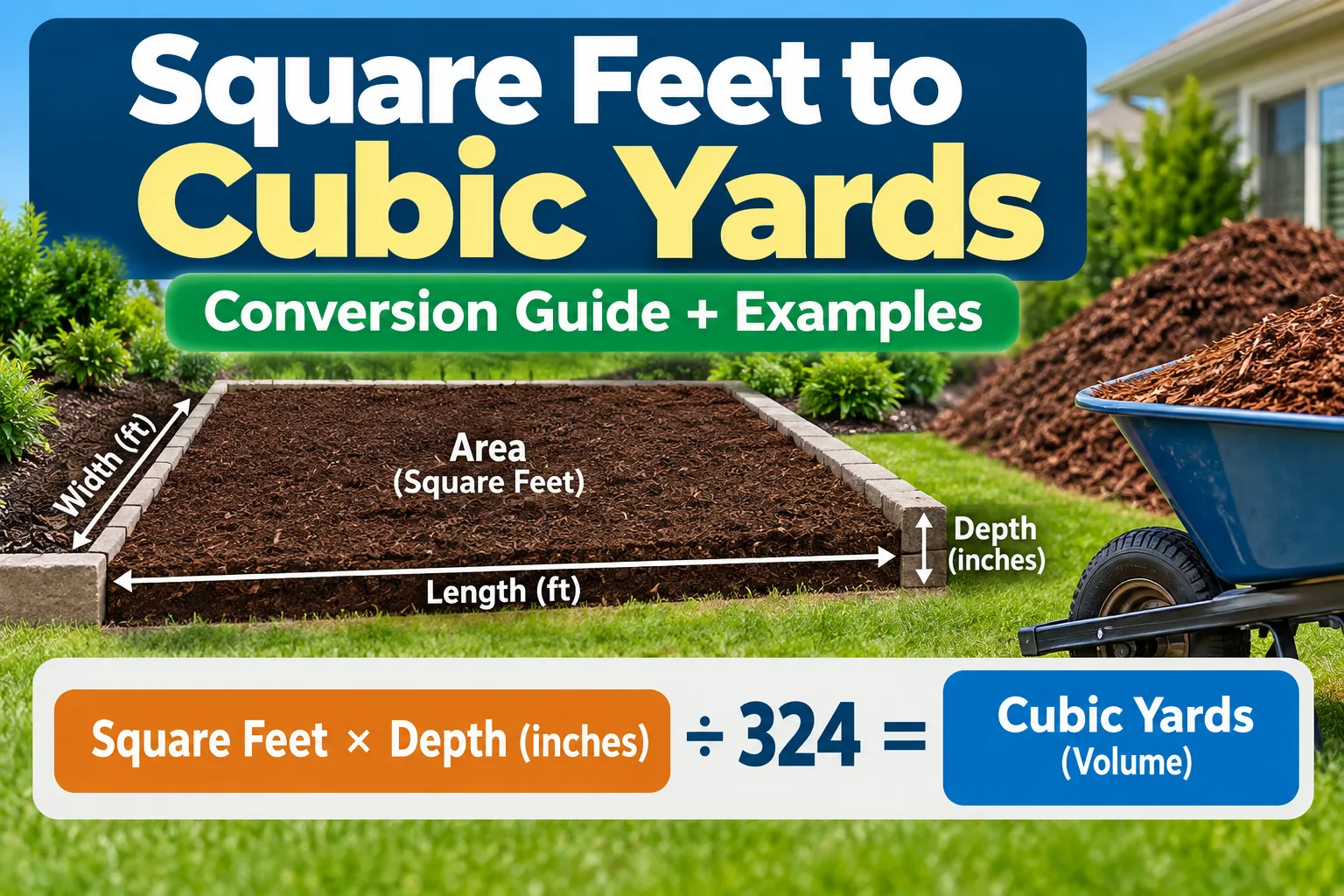
Converting square feet to cubic yards means adding a depth to a flat area, since square feet measure area and cubic yards measure volume. This guide gives you the formula, a quick reference table, and worked examples for mulch, soil, gravel and sand.
Prefer to skip the math? Enter your area and depth into the free Cubic Yards Calculator for an instant result, including bags and weight.
The quick formula
If you know the depth in inches, use this shortcut:
Cubic yards = (Area in sq ft × Depth in inches) ÷ 324
The number 324 comes from 12 inches per foot × 27 cubic feet per cubic yard. Dividing by 324 does both conversions in one step, so you never have to convert inches to feet separately.
The step-by-step method
If you would rather work through it in feet, the formula is the same math in two steps:
- Convert the depth from inches to feet: depth in inches ÷ 12.
- Multiply the area (sq ft) by the depth in feet to get cubic feet.
- Divide the cubic feet by 27 to get cubic yards.
For example, 100 sq ft at a 3-inch depth: 3 ÷ 12 = 0.25 ft. Then 100 × 0.25 = 25 cubic feet. Then 25 ÷ 27 = 0.93 cubic yards. The shortcut gives the same answer: (100 × 3) ÷ 324 = 300 ÷ 324 = 0.93.
Quick reference: cubic yards per 100 square feet
Use this table for a fast estimate, then scale it to your actual area. For example, for 250 sq ft, take the 100 sq ft value and multiply by 2.5.
| Depth | Cubic yards per 100 sq ft |
|---|---|
| 1 inch | 0.31 |
| 2 inches | 0.62 |
| 3 inches | 0.93 |
| 4 inches | 1.23 |
| 6 inches | 1.85 |
| 12 inches (1 ft) | 3.70 |
Four worked examples
1. Small garden bed (mulch): 50 sq ft at a 2-inch depth.
(50 × 2) ÷ 324 = 100 ÷ 324 = 0.31 cubic yards.
2. Lawn top-dressing (topsoil): 1,500 sq ft at a 1-inch depth.
(1,500 × 1) ÷ 324 = 1,500 ÷ 324 = 4.63 cubic yards.
3. Driveway base (gravel): 800 sq ft at a 4-inch depth.
(800 × 4) ÷ 324 = 3,200 ÷ 324 = 9.88 cubic yards.
4. Large planting area (mulch): 5,000 sq ft at a 3-inch depth.
(5,000 × 3) ÷ 324 = 15,000 ÷ 324 = 46.30 cubic yards.
What if my area isn’t a rectangle?
The square-feet-to-cubic-yards formula works the same way once you have the area, no matter the shape:
- Circle: area = π × (diameter ÷ 2)²
- Triangle: area = ½ × base × height
- Irregular shape: split it into rectangles or triangles, find each area, and add them together
Once you have the total square footage, apply the same formula above. The Cubic Yards Calculator does this automatically for rectangles, circles and triangles, or you can enter a known area directly.
Common mistakes
- Forgetting to convert depth. Depth is usually given in inches, but the volume formula needs feet (or use the ÷ 324 shortcut, which handles inches directly).
- Mixing units. If your area is in square meters, convert to square feet first, or use metric depth and volume formulas consistently rather than mixing systems.
- Rounding too early. Small rounding errors early in the calculation can shift the final bag count. Round only the final answer.
- Forgetting extra material. Many suppliers recommend ordering 5–10% more to cover an uneven grade, compaction and spillage.
Quick answers
How many cubic yards are in 100 square feet? It depends on the depth. At a 3-inch depth, 100 sq ft is about 0.93 cubic yards. See the table above for other depths.
What is the formula to convert square feet to cubic yards? Cubic yards = (area in sq ft × depth in inches) ÷ 324, or area × depth in feet ÷ 27 if you convert depth to feet first.
Does the formula change for gravel, sand or soil? No. The volume formula is the same for every loose material; only the recommended depth and the material’s weight per cubic yard differ.
Convert your own numbers
Enter your area and depth into the Cubic Yards Calculator for an instant result in cubic yards, cubic feet and cubic meters, plus bags needed and an estimated weight. Once you have your cubic yards, see how many bags of mulch are in a cubic yard to work out bag counts by hand. More questions? See the FAQ.
Figures in this guide are general estimates. Actual material needs can vary with ground slope, compaction and supplier measurement. Results are for reference only.
Leave a Reply