
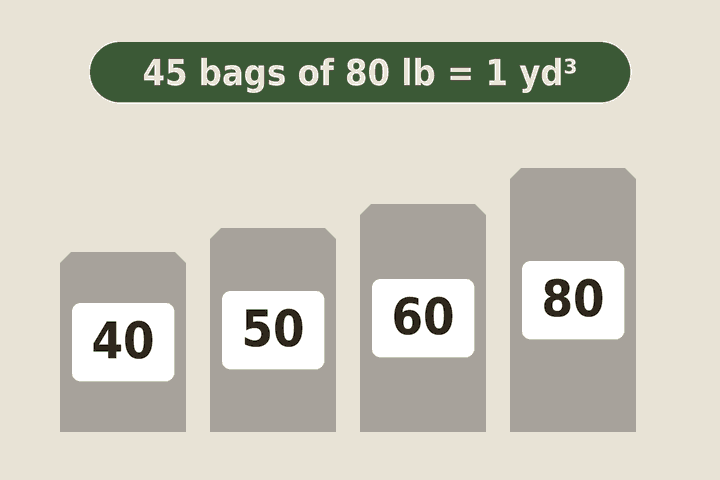
To work out how many bags of concrete you need, find the volume of your pour in cubic feet, then divide by the yield of one bag. An 80 lb bag of standard concrete mix yields about 0.60 cubic feet, so it takes about 45 bags of 80 lb concrete to make one cubic yard.
Quick answer: bags = cubic feet ÷ bag yield. A 10 × 10 ft slab that is 4 inches thick holds 33.3 cubic feet, which is about 56 bags of 80 lb concrete, or 62 bags if you add 10% extra.
To skip the math, the Concrete Calculator works out the volume and the bag count for slabs, footings, walls, round holes and stairs in 40, 50, 60, 80 and 90 lb bags.
How many bags of concrete are in a cubic yard?
A cubic yard is 27 cubic feet. Divide 27 by the yield of your bag to get the number of bags per cubic yard. The yields below come from QUIKRETE’s data sheet for its Concrete Mix.
| Bag size | Yield per bag | Bags per cubic yard |
|---|---|---|
| 40 lb | about 0.30 ft³ | 90 |
| 50 lb | about 0.375 ft³ | 72 |
| 60 lb | about 0.45 ft³ | 60 |
| 80 lb | about 0.60 ft³ | 45 |
The bags-per-yard column is simple arithmetic on those yields. Other brands and products can differ: lightweight or high-yield mixes make more concrete per bag, and some specialty mixes come in different bag sizes. Always use the yield printed on the bag you are actually buying.
How to calculate how many bags you need
- Find the volume in cubic feet using the formula for your shape (below).
- Add a little extra, usually 5–10%, for uneven ground and spillage.
- Divide by the bag yield (0.60 for an 80 lb bag, 0.45 for 60 lb, 0.375 for 50 lb, 0.30 for 40 lb) and round up to a whole bag.
| Shape | Volume in cubic feet |
|---|---|
| Slab, patio or sidewalk | length (ft) × width (ft) × thickness (in) ÷ 12 |
| Footing, wall or curb | length (ft) × width (ft) × height or depth (ft) |
| Round hole or column | about 0.000454 × diameter (in)² × depth (in) |
The round-hole shortcut is π × radius² × depth with the units already converted to cubic feet. To convert cubic feet to cubic yards, divide by 27; see square feet to cubic yards for the same conversion on any material.
Bags of concrete per 100 square feet
Use this chart for any flat slab. For a different area, scale it: 250 sq ft needs 2.5 times these numbers.
| Thickness | Volume | 40 lb bags | 50 lb bags | 60 lb bags | 80 lb bags |
|---|---|---|---|---|---|
| 4 inches | 33.3 ft³ (1.23 yd³) | 112 | 89 | 75 | 56 |
| 5 inches | 41.7 ft³ (1.54 yd³) | 139 | 112 | 93 | 70 |
| 6 inches | 50.0 ft³ (1.85 yd³) | 167 | 134 | 112 | 84 |
Bag counts are rounded up and do not include any extra allowance. Bagged concrete mix is designed for pours about 2 inches thick or more. The right thickness for your project depends on how it will be used and on local requirements.
Worked examples
A 10 × 10 ft slab, 4 inches thick
10 × 10 × 4 ÷ 12 = 33.33 cubic feet (1.23 cubic yards). At 0.60 cubic feet per 80 lb bag, that is 33.33 ÷ 0.60 = 55.6, so 56 bags. In 60 lb bags it is 75, and in 40 lb bags it is 112. With 10% extra (36.67 cubic feet), plan on 62 bags of 80 lb.
An 8 × 10 ft shed pad, 4 inches thick
8 × 10 × 4 ÷ 12 = 26.67 cubic feet, almost exactly one cubic yard. That is 45 bags of 80 lb (49 with 10% extra) or 60 bags of 60 lb (66 with 10% extra). Check the shed maker’s foundation instructions for the thickness and base they require.
A sidewalk 3 ft wide, 20 ft long and 4 inches thick
3 × 20 × 4 ÷ 12 = 20 cubic feet (0.74 cubic yards). That is 34 bags of 80 lb or 45 bags of 60 lb, and 37 or 49 bags with 10% extra.
A footing 16 in wide, 8 in deep and 40 ft long
These are example dimensions only; footing size is set by your local code and soil. (16 ÷ 12) × (8 ÷ 12) × 40 = 35.56 cubic feet (1.32 cubic yards). That is 60 bags of 80 lb or 80 bags of 60 lb, and 66 or 87 bags with 10% extra.
How many bags of concrete for a fence post?
It depends on the hole size and the bag size. Take a 4 × 4 wood post in a hole 10 inches wide and 24 inches deep. The hole holds 0.000454 × 10² × 24 = about 1.09 cubic feet. Per post, rounded up, that is:
- 2 bags of 80 lb (1.09 ÷ 0.60 = 1.8)
- 3 bags of 60 lb (1.09 ÷ 0.45 = 2.4)
- 3 bags of 50 lb (1.09 ÷ 0.375 = 2.9)
- 4 bags of 40 lb (1.09 ÷ 0.30 = 3.6)
For a whole fence, work from the total volume instead of rounding each hole. Ten posts need 10.9 cubic feet, which is 19 bags of 80 lb, 25 bags of 60 lb, 30 bags of 50 lb or 37 bags of 40 lb. The post itself takes up part of the hole, so this runs slightly generous. If you put gravel in the bottom of the hole, count only the depth that will actually be filled with concrete.
For hole width and depth by fence height, see how deep should fence posts be, and for how many posts you need, see fence post spacing or the Fence Calculator. In the Concrete Calculator, choose the Round shape, enter the hole’s diameter and depth, and set Quantity to your number of posts. Some post-setting mixes have their own bag sizes and yields, so check the label.
How much extra concrete should you order?
Adding 5–10% is common. Subgrade is rarely perfectly flat, forms bow slightly, and some concrete is lost to spillage. Running out partway through a pour is worse than having a few bags left over, because a pour that stops and restarts can leave a weak seam.
Bags or ready-mix?
Bags suit small jobs: posts, small pads and repairs. A cubic yard is 45 bags of 80 lb, or 3,600 lb of dry mix to lift, mix and place before it sets. Once a pour reaches about a cubic yard or more, ask a local supplier for a ready-mix quote and compare it with the cost of bags. Ask about minimum loads and short-load fees, since small deliveries are often charged extra. After the pour, see concrete curing time for how long it needs to cure.
Common mistakes
- Forgetting to convert thickness from inches to feet (divide by 12).
- Dividing by the bag’s weight instead of its yield in cubic feet.
- Using the 80 lb yield for 60 lb bags, or the reverse.
- Assuming every brand and product yields the same amount.
- Buying exactly the calculated number with no allowance.
- Rounding down instead of up.
FAQ
How many 80 lb bags of concrete are in a yard?
About 45. A cubic yard is 27 cubic feet and an 80 lb bag yields about 0.60 cubic feet, so 27 ÷ 0.60 = 45.
How many 60 lb bags make a yard?
About 60, since a 60 lb bag yields about 0.45 cubic feet (27 ÷ 0.45 = 60).
How many bags of concrete for a 10 × 10 slab?
At 4 inches thick, 56 bags of 80 lb (62 with 10% extra). At 6 inches thick, 84 bags of 80 lb.
How much area does an 80 lb bag of concrete cover?
Divide the yield by the thickness in feet. At 4 inches thick, one 80 lb bag covers about 1.8 square feet (0.60 ÷ 0.333). At 6 inches thick, it covers about 1.2 square feet.
How many bags of concrete do I need for a fence post?
About 2 bags of 80 lb for a 10-inch-wide, 24-inch-deep hole, or 3 bags of 60 lb. A wider or deeper hole needs more, so work out the hole volume first.
Do all brands of concrete have the same yield?
No. Yield depends on the product. Use the cubic-foot yield printed on the bag or the manufacturer’s data sheet.
Bottom line
Find the volume in cubic feet, add 5–10%, divide by the bag’s yield and round up. For standard mix that means about 45 bags of 80 lb, 60 bags of 60 lb, 72 bags of 50 lb or 90 bags of 40 lb per cubic yard. To let the calculator do it, use the Concrete Calculator.
Source for bag yields: QUIKRETE Concrete Mix No. 1101 data sheet. Bag yields are approximate and vary by product. Slab thickness, footing size and reinforcement depend on the project and local code, and this guide is not a structural design. Confirm requirements before you pour.
Leave a Reply