
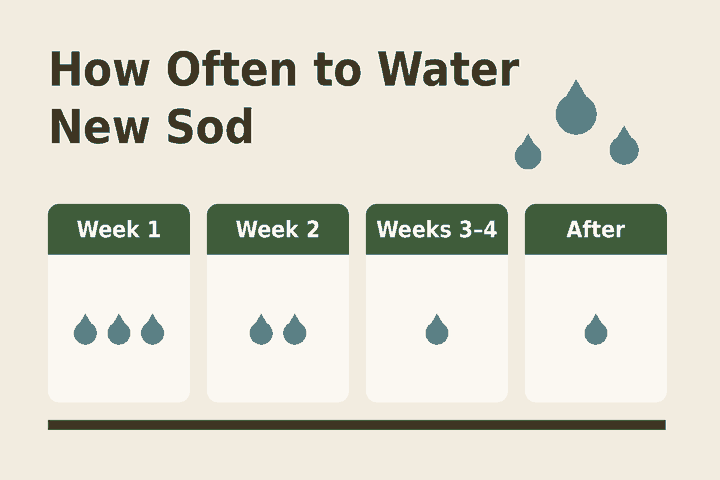
Newly laid sod has to stay moist from the day it goes down until its roots grow into the soil underneath. In practice that often means watering every day for the first couple of weeks, and more than once a day in hot, dry or windy weather, then cutting back as the sod roots.
Quick answer: water new sod as soon as it is laid, then keep the soil beneath it moist but not soggy. Plan on daily watering for the first week or two (more than once a day in summer heat), test for rooting after about 10 to 14 days, then taper to every other day and on to normal lawn watering of up to about 1 inch a week, including rain.
For the full installation steps, see how to lay sod. To work out how many rolls or pallets you need, use the Sod Calculator.
New sod watering schedule
No single schedule fits every yard. Sun, wind, rain, soil type and grass species all change how fast sod dries out, and university sources give slightly different timetables. This plan follows Mississippi State University Extension, with checks against other universities.
| Stage | What to do |
|---|---|
| Installation day | Start watering as soon as a section is down; don’t wait until the whole lawn is finished. Water until the soil under the sod is soft. |
| Week 1 | Keep the soil soft underfoot but not oozing wet. In the heat of summer, that can take more than one watering a day. |
| Week 2 | Daily watering is typically enough. Adjust for rain, and test for rooting between days 10 and 14. |
| Weeks 3–4 | Once the sod has rooted, cut back gradually. After 2 to 3 weeks, every other day can be enough. |
| After rooting | Move to normal lawn watering: if rain isn’t coming, no more than about 1 inch of water a week. |
University of Maryland Extension puts it more simply: water sod regularly for the first 2 to 3 weeks after laying, which may mean daily. Use the condition of your own sod, not the calendar, as the final decider.
How to tell when new sod needs water
Two quick checks beat guessing:
- The screwdriver test. Push a screwdriver down through the sod into the soil. If it is hard to push in, the soil is dry. If it comes out cool or damp, the moisture is about right (Mississippi State University Extension).
- Lift a corner. The underside of the sod and the soil beneath it should both feel damp.
Color is the warning sign. Sod that turns bluish-gray and starts to wilt is not getting enough water, according to Mississippi State University Extension.
How long should you water each time?
There is no fixed number of minutes, because sprinklers deliver very different amounts of water. The aim is for water to soak through the sod and wet the soil underneath. University of Maryland Extension notes that sod may need a slightly heavier watering than seed to reach the soil below, and gives about ¼ inch per session for seed as a reference point.
To see what your sprinkler actually delivers, set out a few shallow cans (pie pans or tuna cans work), run the sprinkler for a set time and measure the water collected. Mississippi State University Extension says hand watering with a hose while checking the soil is the most reliable method, and that a sprinkler is only adequate if you move it often enough to cover everything. If water starts running off before it soaks in, split the watering into shorter rounds with a break in between.
When to water: morning, midday or evening?
Sod growers commonly recommend watering in the morning, when there is less wind and evaporation and the grass has the day to dry. They also advise against late-evening or overnight watering, since a wet lawn at night can encourage disease. If the weather is hot enough that the sod dries out between waterings, add another watering instead of letting it dry. Mississippi State University Extension notes that summer heat can call for more than one irrigation a day.
How long does sod take to root?
Sod typically roots in 2 to 3 weeks, according to University of Maryland Extension and Colorado State University’s PlantTalk. University of Minnesota Extension recommends a tug test after about 10 to 14 days. Full establishment takes longer: a University of Maryland Extension comparison puts sod establishment at around 3 to 4 weeks after laying. Cool weather, dry or compacted soil, air pockets under the sod and inconsistent watering can all slow rooting.
The tug test
- Gently lift a corner or edge of a piece in a few different spots.
- Look underneath for white, young roots.
- If the sod resists, roots are growing into the soil. If it lifts with no resistance, the roots haven’t taken hold yet: keep watering and test again in a few days.
Don’t yank hard, or you can tear the new roots. Stay off the sod until it has fully rooted, as University of Maryland Extension advises.
Signs of too little or too much water
| Not enough water | Too much water |
|---|---|
| Bluish-gray or wilting grass | Soil so soft and muddy you can’t walk across it |
| Dry, hard soil under the sod; the screwdriver won’t go in | Standing water or runoff |
| Edges drying out and seams opening up | Yellowing grass and spongy sod that never firms up |
Turf roots need oxygen too. Mississippi State University Extension warns that too much irrigation wastes water and encourages disease, weeds and pests, so aim for moist, not soaked.
Hot, dry or windy weather
Sod dries faster in heat, sun and wind, so expect to water more often, sometimes more than once a day. Never let new sod dry out during establishment, as University of Maryland Extension puts it. Check the edges, slopes and areas beside pavement first, since those spots often dry out before the middle of the lawn.
Cool weather and fall
Cooler weather means less evaporation and often more rain, so sod needs less water, according to Mississippi State University Extension. Don’t water on a fixed schedule: check moisture with the screwdriver or by lifting a corner, and skip a watering when rain has kept the soil damp. Keep checking, though, because new sod can still dry out in cool, dry, windy weather, and rooting can take longer when it is cold.
Watering after the sod has rooted
Once the sod passes the tug test, gradually water less often. University of Minnesota Extension recommends keeping sod moist but not saturated until it is firmly rooted, then reducing watering step by step. For an established lawn, Mississippi State University Extension says no more than 1 inch of water a week is needed when rain isn’t in the forecast. Rainfall counts toward that total, so use your cans to measure what your sprinkler adds.
It is also rarely necessary to mow new sod right after installation, and frequent watering can leave the soil too soft for a mower. Wait until the sod has rooted and the soil is firm. The how to lay sod guide covers mowing and foot traffic.
Common watering mistakes
- Waiting until the whole lawn is laid before watering the first sections.
- Watering lightly, so only the top of the sod gets wet.
- Following a calendar and ignoring rain, heat and wind.
- Letting edges, seams and slopes dry out.
- Watering so much that the soil stays soggy.
- Walking on the sod before it passes the tug test.
- Cutting back too early, before the roots hold.
FAQ
How often should I water new sod?
Keep the soil beneath it moist from day one. That often means daily watering for the first week or two (more than once a day in hot weather), then every other day once the sod has rooted, and finally normal lawn watering.
How long should I water new sod each time?
Long enough for water to soak through the sod and wet the soil below. The time depends on your sprinkler, so measure its output with shallow cans and check the soil with a screwdriver.
Can you overwater new sod?
Yes. Soggy, muddy soil starves roots of oxygen and encourages disease, weeds and pests. The soil should be moist and soft underfoot, not oozing.
How long does it take for sod to root?
Typically 2 to 3 weeks. Do a tug test after about 10 to 14 days: if the sod resists lifting, roots are growing into the soil.
Should I water new sod if it rained?
Check first. Rain counts, so if the soil under the sod is still damp and soft, you can skip a watering. If it has dried out, water as normal.
How often should I water new sod in cool weather?
Less often than in summer, because there is less evaporation. Go by soil moisture instead of a fixed schedule, and keep checking until the sod has rooted.
When can I walk on new sod?
Stay off it until it has rooted. The tug test tells you: if the sod resists lifting, light traffic is far less likely to do damage.
Bottom line
Keep the soil under new sod moist but not soggy from the first day. That is often daily for the first week or two, with extra watering in hot weather, then a tug test at 10 to 14 days and a gradual cut back once it has rooted. Read how to lay sod for the installation steps, and use the Sod Calculator before you order.
Sources
- Mississippi State University Extension: Sod Installation and Maintenance (P2951)
- University of Maryland Extension: Lawn Seeding or Sodding
- University of Maryland Extension: Sod
- University of Minnesota Extension: Seeding and sodding home lawns
- Colorado State University PlantTalk: Sodding a Lawn
Watering needs vary with climate, grass species, soil and weather. If your sod supplier or local extension office gives different instructions, follow theirs.
Leave a Reply