
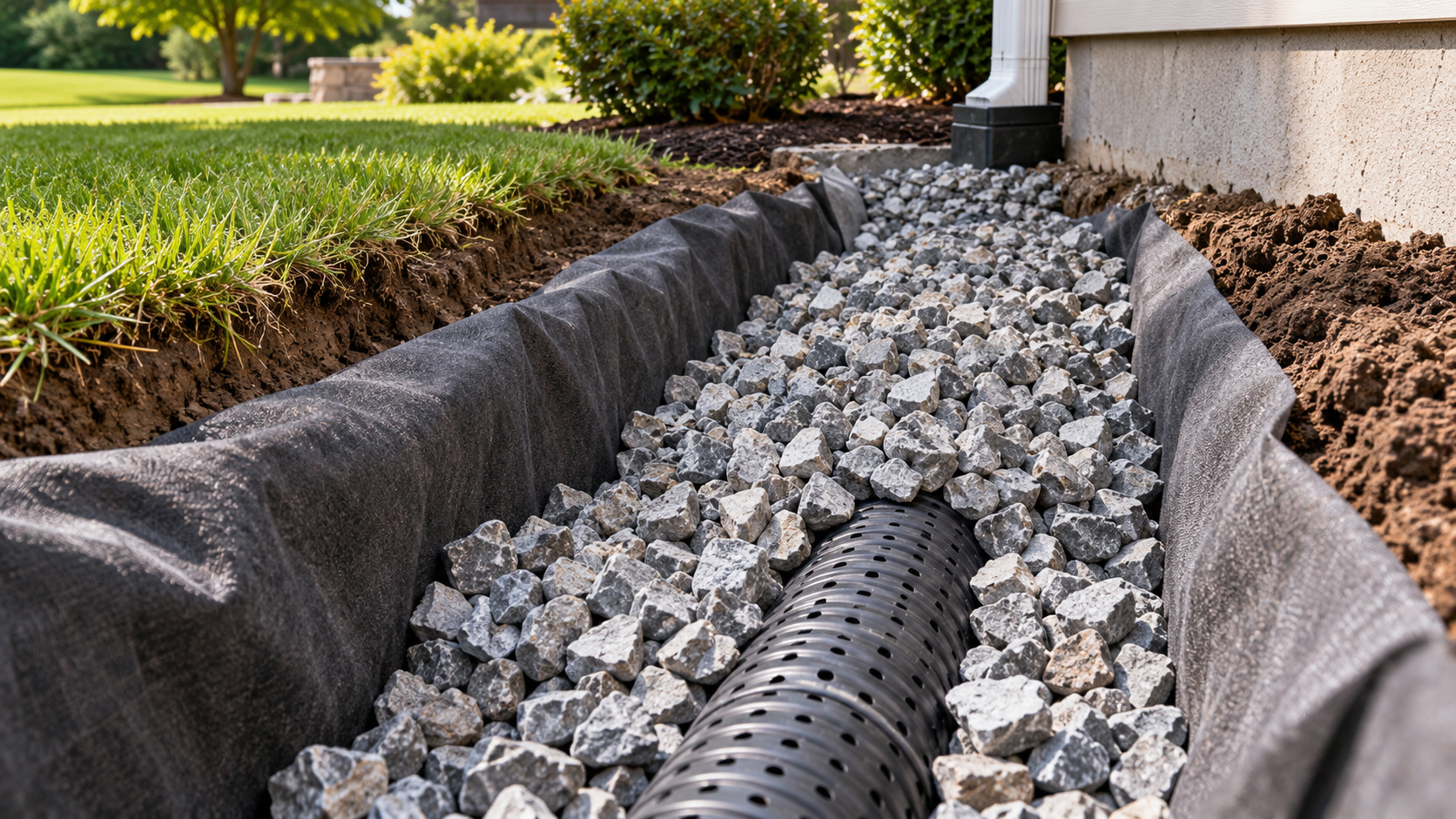
Crushed stone for drainage can work very well when the right stone size and gradation are used. The key is not simply choosing “crushed stone,” but choosing a material with enough open space between the particles for water to move through.
For many residential drainage projects, clean 3/4-inch crushed stone or a locally equivalent #57 stone is a practical starting point because it provides good drainage while remaining stable enough for trenches, retaining walls, and other landscape applications. Supplier gradations vary, so confirm the actual particle-size range before ordering.
Materials containing a lot of stone dust or fines can behave very differently. They compact tightly, which is useful for structural bases but usually makes them less suitable as the main high-flow drainage layer.
If you already know the dimensions of your project, use the CalcWoven Crushed Stone Calculator to estimate cubic yards and tons of stone.
Is Crushed Stone Good for Drainage?
Yes. Crushed stone can be excellent for drainage when the material is clean or washed, relatively uniform in size, low in fines, and installed as part of a drainage system that has a suitable path for water to leave the area.
Water moves through the voids between the stones. Open-graded aggregate leaves more connected void space than dense-graded material, so water can pass through more freely.
Best Crushed Stone Sizes for Drainage
| Application | Common stone choice |
|---|---|
| French drain | Clean #57 or roughly 3/4-inch stone |
| Behind retaining wall | Clean drainage stone sized to the wall system |
| Foundation drainage | Clean drainage stone around the pipe |
| Driveway drainage trench | #57 or another clean open-graded stone |
| Deep drainage reservoir | Larger clean stone may be specified |
| Landscape drainage | Clean crushed stone, river rock, or similar aggregate |
| Compact structural base | Crusher run or dense-graded aggregate |
The actual material available from local suppliers may use different naming systems, so ask about stone size, gradation, and fines content, not only the product name.
Is #57 Stone Good for Drainage?
Yes. #57 stone is widely used for drainage and construction applications. Depending on the local specification and quarry, the exact particle-size range can vary, so the number alone should not replace checking the supplier’s gradation.
Its advantages can include good drainage, useful stability, availability from many suppliers, and suitability around drainage pipe or behind retaining walls when the project specification allows it.
What Is Clean Crushed Stone?
“Clean” crushed stone generally means the aggregate contains little fine stone dust compared with a dense-graded base material.
- clean stone
- washed stone
- drainage stone
- drain rock
- open-graded aggregate
These terms are not perfectly interchangeable in every region. The most useful question for the supplier is: Does this material contain fines, and what is its gradation?
Clean Stone vs Crusher Run
Clean crushed stone
Clean stone contains relatively uniform particles with limited fines. It is commonly used where water needs to move through the aggregate, including drainage trenches, some French drains, and retaining-wall drainage zones.
Crusher run
Crusher run normally contains larger crushed particles plus smaller particles and stone dust. Those fines fill many of the voids when compacted, which makes crusher run useful for driveway and hardscape bases but generally less free-draining than clean open-graded stone.
If you are building a hardscape base rather than a drainage trench, see the Paver Base Calculator.
Best Stone for a French Drain
A typical French drain uses a perforated pipe surrounded by clean gravel or drainage stone. Washington State University Extension describes French drains as geotextile-lined trenches with perforated pipe surrounded by gravel, with the fabric helping prevent soil from filling the voids between the aggregate.
For many residential systems, clean stone around 3/4 inch is commonly used, but the final stone size should match local practice, soil conditions, pipe size, and the drainage design.
Should French Drain Stone Have Fines?
Usually, a high-flow drainage trench benefits from clean aggregate rather than a dense material containing a large amount of stone dust. Fine particles can occupy the voids that water would otherwise move through.
Geotextile separation can also help prevent surrounding soil from migrating into the drainage aggregate. The exact fabric and installation detail should match the soil and system design.
Crushed Stone Behind a Retaining Wall
Drainage behind a retaining wall is important because excess water can increase pressure and moisture in the retained soil. Retaining-wall systems commonly use a drainage aggregate zone together with grading and, where required, drain pipe.
Allan Block’s installation guidance emphasizes water management, wall rock, and properly vented drain pipe for conditions that require it. Their specifications also call for drainage details to be matched to the wall and site conditions.
For quantity planning, use the CalcWoven Retaining Wall Calculator alongside your crushed-stone estimate. When budgeting the complete build, compare retaining wall prices by material and height, including drainage and site preparation.
Why Retaining Walls Need Drainage Stone
Soil behind a wall can retain water. A drainage aggregate zone helps create a path for incidental water to reach the drain system instead of remaining trapped behind the facing.
Drainage stone does not replace engineered wall design. Taller, reinforced, sloped, or otherwise structural walls may require specific drainage, reinforcement, and permitting details.
Crushed Stone for Driveway Drainage
Crushed stone can be used in side drains, French drains, wet-area stabilization, and around drainage pipe near driveways. However, the material used as the structural driveway base may be different from the clean aggregate used in a drainage trench.
A driveway base often benefits from compactable material, while a drainage trench usually benefits from cleaner, more open aggregate. Do not assume one product is ideal for both jobs.
Crushed Stone vs River Rock for Drainage
| Factor | Crushed Stone | River Rock |
|---|---|---|
| Drainage | Very good when clean | Very good when clean |
| Shape | Angular | Rounded |
| Stability | Generally better interlock | Can shift more easily |
| Appearance | More utilitarian | Often more decorative |
| Drainage trenches | Common choice | Can work |
| Visible landscaping | Functional | Popular visually |
For visible landscape drainage, river rock can be attractive. Estimate it separately with the River Rock Calculator.
Crushed Stone vs Pea Gravel for Drainage
Pea gravel drains well when clean, but its rounded particles can move more easily under load. Angular crushed stone generally interlocks more effectively, which can be useful where both drainage and stability matter.
Why Fines Reduce Drainage
Imagine a container filled with large stones. There are visible gaps between them. Add smaller particles and those gaps begin to fill.
The same principle applies to aggregate layers: more fines usually mean less open void space. This is why dense-graded material compacts well, while open-graded material is normally selected when freer water movement is the priority.
Is Stone Dust Good for Drainage?
Stone dust alone is generally not the first choice for a high-flow drainage layer because the fine particles can compact tightly. It is more commonly associated with leveling, bedding, paths, or certain compacted hardscape applications.
What Size Crushed Stone Is Best for Drainage?
For many household drainage projects, clean aggregate around 3/4 inch provides a practical balance between permeability and stability. The ideal size still depends on soil conditions, water volume, trench dimensions, pipe size, expected load, and the project specification.
When Larger Drainage Stone Makes Sense
Larger clean stone may be specified for deep drainage reservoirs, infiltration areas, or other systems that need larger void spaces. Bigger is not automatically better for every residential French drain; the aggregate needs to work with the pipe, fabric, soil, trench, and outlet.
Do You Need Landscape Fabric Under Drainage Stone?
Geotextile can help separate soil from drainage aggregate and reduce migration of fine soil particles into the void spaces. Washington State University Extension specifically notes this soil-separation role in French-drain construction.
Fabric choice and placement are project-specific. Some engineered drainage systems use different details, so follow the approved design where one exists.
How Deep Should Drainage Stone Be?
There is no universal depth. French-drain depth depends on where the water is coming from and where it can discharge. Retaining-wall stone depth depends on the wall design. Driveway drains depend on pipe elevation, grading, outlet location, and site conditions.
For drainage systems, the outlet and slope are just as important as the amount of stone. Colorado State University Extension notes that a French drain must flow toward an outlet rather than simply storing water in place.
Does Crushed Stone Alone Fix Standing Water?
Not always. Standing water can be caused by poor grading, compacted soil, clay, roof runoff, blocked drainage, high groundwater, or a low spot with no outlet.
Stone provides storage and flow paths, but a drainage system still needs somewhere appropriate for the water to go.
Drainage Stone Around Foundation Walls
Clean aggregate is often part of foundation drainage systems because it creates a permeable zone around drainage pipe. Foundation drainage may also involve waterproofing, drainage board, footing drains, grading, and a suitable discharge point.
If water is entering a basement or affecting a foundation, the cause should be evaluated before relying on stone alone.
How Much Crushed Stone Do You Need?
For a simple rectangular trench:
Volume = length × width × depth
When all measurements are in feet:
Cubic yards = length × width × depth ÷ 27
Example: a trench 40 ft long, 2 ft wide, and 1.5 ft deep has a gross volume of 120 cubic feet, or about 4.44 cubic yards. A large pipe inside the trench occupies some of that volume.
Use the CalcWoven Crushed Stone Calculator for a faster estimate.
Cubic Yards vs Tons of Crushed Stone
Suppliers may sell crushed stone by cubic yard or ton. The conversion is not exact because density varies with rock type, particle size, gradation, and moisture. For ordering, use the supplier’s actual weight-per-yard figure when available.
For other aggregate projects, the Gravel Calculator can also help with quantity planning.
What to Ask Your Stone Supplier
- Is the stone washed or clean?
- Does it contain stone dust or fines?
- What is the actual gradation?
- Is it equivalent to a local #57 stone specification?
- What material is normally supplied for drainage pipe in this area?
- What is its approximate weight per cubic yard?
Common Crushed Stone Drainage Mistakes
Using dense base material as the drainage layer
Crusher run and similar materials compact well, but their fines reduce open void space compared with clean drainage aggregate.
Forgetting the outlet
A trench full of stone can still stay saturated when there is nowhere suitable for the water to discharge.
Allowing soil to contaminate the stone
Fine soil can migrate into aggregate voids and reduce drainage performance over time.
Ignoring surface grading
Subsurface drainage works best as part of a site plan that also directs surface runoff appropriately.
Crushed Stone or Gravel: Which Is Better for Drainage?
Both can work. The more important factors are gradation, cleanliness, fines content, particle stability, and the requirements of the project. Clean angular crushed stone can provide both drainage and interlock, while rounded gravel may move more easily.
Frequently Asked Questions
What is the best crushed stone for drainage?
For many residential projects, clean aggregate around 3/4 inch or a locally equivalent #57 stone is a common starting point. Always confirm the actual gradation and project requirements.
Is #57 stone good for French drains?
Clean #57 stone is commonly used for drainage, but local specifications vary. The important characteristics are suitable particle size, low fines, and compatibility with the drain design.
Does crusher run drain well?
It is generally less free-draining than clean open-graded stone because the fines compact into the void spaces. Its strength is as a compactable base material.
Is washed stone better for drainage?
When washing removes excess fines, it can improve open void space and drainage compared with a similar fines-heavy aggregate.
Is river rock better than crushed stone for drainage?
Both can drain effectively when clean. Crushed stone generally offers more angular interlock, while river rock is often chosen for visible landscaping.
Can I put crushed stone directly on soil?
You can in some applications, but soil can migrate into the stone. Geotextile separation may be appropriate depending on the soil and drainage design.
Calculate How Much Crushed Stone You Need
Before ordering drainage stone, use the CalcWoven Crushed Stone Calculator to estimate project volume, cubic yards, and tons. Then confirm the actual gradation and density with your local supplier.
Sources and Methodology
This guide cross-checks drainage principles against Washington State University Extension, Colorado State University Extension, and Allan Block retaining-wall installation guidance. Aggregate names and gradations vary by supplier and region, so local specifications should take priority over generic product labels.
Final Takeaway
Crushed stone for drainage works best when the aggregate is clean, open enough for water movement, and matched to the project. For many residential systems, clean stone around 3/4 inch or a locally equivalent #57 stone is a practical starting point.
The key distinction is often not stone size alone, but whether the material contains fines. Choose the aggregate based on what the layer needs to do, provide a suitable drainage path and outlet, and use the CalcWoven calculator to estimate quantity before ordering.