
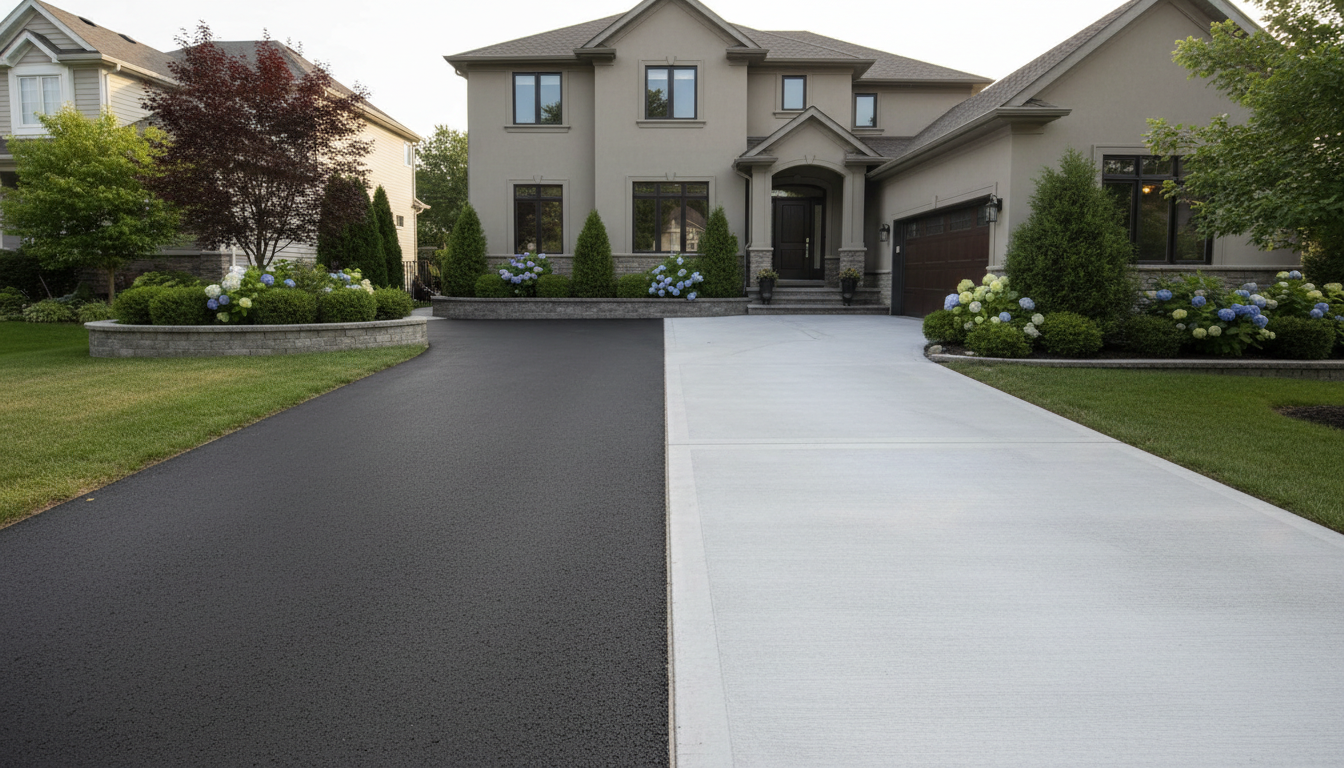
The asphalt driveway cost vs concrete comparison usually comes down to more than the upfront price. Asphalt is often cheaper to install, while concrete generally lasts longer and needs less routine maintenance.
For 2026 planning, a practical installed-cost range is roughly $5 to $15 per square foot for asphalt and $6 to $20 per square foot for concrete. These are broad planning ranges, not contractor quotes. Current consumer cost guides vary because they use different assumptions for location, demolition, base preparation, finish level, and labor.
Before comparing materials, calculate your driveway area and asphalt quantity with the CalcWoven Asphalt Driveway Calculator.
Asphalt vs Concrete Driveway Cost at a Glance
| Factor | Asphalt | Concrete |
|---|---|---|
| Typical installed cost | About $5–$15/sq ft | About $6–$20/sq ft |
| Upfront cost | Usually lower | Usually higher |
| Typical lifespan | About 15–30 years | About 30–40+ years |
| Routine maintenance | More frequent | Usually less frequent |
| Repairs | Often easier and cheaper | Can be more visible and expensive |
| Cold-climate fit | Generally more flexible | More vulnerable to freeze-thaw cracking |
| Hot-climate fit | Can soften in extreme heat | Generally handles heat well |
| Decorative options | Limited | Many finishes available |
HomeGuide currently lists asphalt at about $5–$12 per square foot and concrete at $6–$15. NerdWallet cites higher ranges of about $7–$15 for asphalt and $8–$20 for concrete. That spread is exactly why project scope matters when comparing estimates.
Asphalt Driveway Cost Per Square Foot
A new asphalt driveway may fall anywhere from the mid-single digits to the mid-teens per square foot depending on the site. Lower-cost jobs typically have easy access, a sound base, simple geometry, and little demolition. Costs rise when excavation, grading, drainage work, base reconstruction, or old-pavement removal is required.
Thickness also changes both material quantity and cost. See How Thick Should Asphalt Be for a Driveway? for a separate construction-focused guide.
Concrete Driveway Cost Per Square Foot
Plain concrete generally starts above basic asphalt, while decorative concrete can cost substantially more. Reinforcement, slab thickness, staining, stamping, exposed aggregate, complex edges, excavation, and site access can all increase the total.
If your project involves estimating concrete volume as well as cost, use the Concrete Calculator.
Asphalt vs Concrete Driveway Cost by Size
| Driveway size | Asphalt planning range | Concrete planning range |
|---|---|---|
| 400 sq ft | $2,000–$6,000 | $2,400–$8,000 |
| 600 sq ft | $3,000–$9,000 | $3,600–$12,000 |
| 800 sq ft | $4,000–$12,000 | $4,800–$16,000 |
| 1,000 sq ft | $5,000–$15,000 | $6,000–$20,000 |
These examples apply the broad planning ranges above. They are useful for early budgeting, but local bids may fall outside them.
Same Driveway, Same Assumptions
For an apples-to-apples comparison, assume a 600-square-foot driveway with easy access, normal residential slope, no major drainage correction, a standard compacted base, and no decorative finish.
- Asphalt at $8 per sq ft = $4,800
- Concrete at $12 per sq ft = $7,200
That is a $2,400 upfront difference, but it does not prove asphalt will always be cheaper over the full life of the driveway.
New Installation vs Replacement
One major reason online estimates differ is that some assume a prepared site while others include demolition and reconstruction.
New driveway on prepared ground
This is usually the simpler scenario. Work may include final grading, base compaction, surface installation, edge finishing, and cleanup.
Full replacement
A replacement can add saw cutting, demolition, hauling, disposal, excavation, base reconstruction, and drainage correction before the new surface is installed. NerdWallet currently cites about $8–$15 per square foot for asphalt replacement compared with roughly $3–$7 per square foot for an overlay, illustrating how much project type changes the number.
Asphalt Resurfacing or Overlay Cost
Asphalt has an important cost advantage when the existing base remains structurally sound: resurfacing may be possible instead of full replacement. An overlay is not appropriate for major settlement, widespread alligator cracking, deep rutting, or serious drainage and base failure.
What Is Usually Included in Driveway Installation Cost?
- Site preparation and grading
- Base material and compaction
- Asphalt or concrete
- Labor and equipment
- Basic edge finishing
- Cleanup
Demolition, disposal, permits, retaining walls, major drainage work, tree-root removal, reinforcement upgrades, and decorative finishes may be separate line items.
Base Preparation Can Matter More Than the Surface
A weak base can shorten the life of either material. Soft soil, poor compaction, inadequate aggregate depth, trapped water, organic soil, and poor grading can all lead to settlement and cracking. A more expensive surface does not compensate for bad foundation work.
Asphalt vs Concrete Maintenance Cost
Asphalt maintenance
- Crack sealing
- Sealcoating
- Patching
- Edge repairs
- Possible resurfacing later in its life
Concrete maintenance
- Crack repair
- Joint maintenance
- Optional sealing
- Slab lifting in some cases
- Partial slab replacement if damage is severe
Asphalt generally needs more routine maintenance, while concrete repairs can be more expensive when serious damage occurs.
Which Is Cheaper Over 20 or 30 Years?
There is no universal winner. A useful long-term comparison is:
Total ownership cost = installation + maintenance + repairs + resurfacing + eventual replacement
Asphalt may remain cheaper when the base is strong, local paving prices are favorable, and resurfacing extends its life. Concrete may become competitive over a long ownership period if it lasts significantly longer with minimal maintenance.
Which Lasts Longer?
Concrete typically has the longer expected service life. HomeGuide currently lists roughly 15–30 years for asphalt and 30–40 years for concrete. Installation quality, drainage, traffic, thickness, and climate can move either material above or below those ranges.
Asphalt vs Concrete in Cold Climates
Asphalt’s flexibility can help it tolerate freeze-thaw movement, although water entering cracks can still cause damage. Concrete can also perform well in cold areas, but freeze-thaw cycles and deicing salts can contribute to cracking, scaling, and spalling. Drainage and base preparation matter for both.
Asphalt vs Concrete in Hot Climates
Concrete generally handles very high surface temperatures better. Asphalt can soften or become more vulnerable to tire marks during extreme heat, though proper mix design and installation can reduce these problems.
Installation and Cure Time
Asphalt is usually faster to install and return to service. HomeGuide lists roughly 1–3 days for new asphalt before normal use, while concrete may require about 7–30 days of curing depending on the mix and contractor guidance. Always follow the installer’s specific instructions.
Repair and Resurfacing
Asphalt repairs often blend into the existing surface more easily, and a structurally sound driveway can sometimes be overlaid. Concrete repairs can be more visible because new and old concrete may not match in color and texture.
Appearance and Finish Options
Concrete offers more appearance choices, including broom finish, exposed aggregate, color, stamped patterns, and decorative borders. Standard asphalt usually has a simpler dark surface, so concrete often wins when customization is a priority.
Asphalt vs Concrete vs Gravel
If both paved options are above budget, gravel may be worth comparing. Gravel usually has a lower upfront cost but needs periodic grading, additional material, rut repair, and drainage maintenance. See our 2026 guide to the cost of putting in a gravel driveway and the Gravel Driveway Calculator.
When Asphalt Is Usually the Better Choice
- Lower upfront cost is the priority.
- You want faster installation.
- Easy repairs and possible future resurfacing matter.
- Decorative finishes are not important.
- You live in a colder climate where flexibility is useful.
When Concrete Is Usually the Better Choice
- You plan to keep the property for a long time.
- Lower routine maintenance matters.
- You want decorative finish options.
- Very hot weather is common.
- You are willing to pay more upfront for potentially longer service life.
Why Online Asphalt vs Concrete Prices Differ So Much
Online cost guides may use different assumptions for new construction, replacement, demolition, base work, driveway thickness, reinforcement, finish level, labor market, access, and region. Compare what each estimate includes before comparing the numbers themselves.
How to Estimate Your Own Driveway Cost
Start with area:
Driveway area = length × width
Then estimate:
Estimated project cost = driveway area × installed cost per square foot
For example, a 60 ft × 12 ft driveway is 720 sq ft. At $8 per sq ft, asphalt would be about $5,760. At $12 per sq ft, concrete would be about $8,640 before special site work or upgrades.
Frequently Asked Questions
Is asphalt cheaper than concrete for a driveway?
Usually, yes. Asphalt generally has a lower upfront installation cost, although local prices and site preparation can narrow or reverse the difference.
Which driveway is cheaper long term?
It depends on maintenance, repair frequency, climate, and lifespan. Asphalt often wins upfront; concrete can become more competitive over a long ownership period.
Does asphalt need more maintenance than concrete?
Generally, yes. Asphalt usually needs more routine crack sealing, sealcoating, patching, or resurfacing, while concrete typically needs less routine work but can be costlier to repair when damaged.
Which lasts longer, asphalt or concrete?
Concrete generally lasts longer, but a well-built asphalt driveway on a strong, well-drained base can outperform poorly installed concrete.
Which is better in hot weather?
Concrete generally performs better in extreme heat, while asphalt can soften at very high surface temperatures.
Calculate Your Asphalt Driveway Cost
Use the CalcWoven Asphalt Driveway Calculator to estimate driveway area, asphalt tons, thickness, and project cost before you compare local contractor quotes.
Sources and Methodology
The planning ranges in this guide were cross-checked against current consumer cost data from HomeGuide and NerdWallet. Because those sources use different project assumptions and price datasets, CalcWoven uses broad planning ranges and recommends comparing itemized local quotes.
Final Takeaway
When comparing asphalt driveway cost vs concrete, asphalt is usually less expensive upfront, while concrete generally offers longer service life, more design choices, and lower routine maintenance. The best choice depends on your budget, climate, base condition, maintenance tolerance, and how long you expect to keep the driveway.