
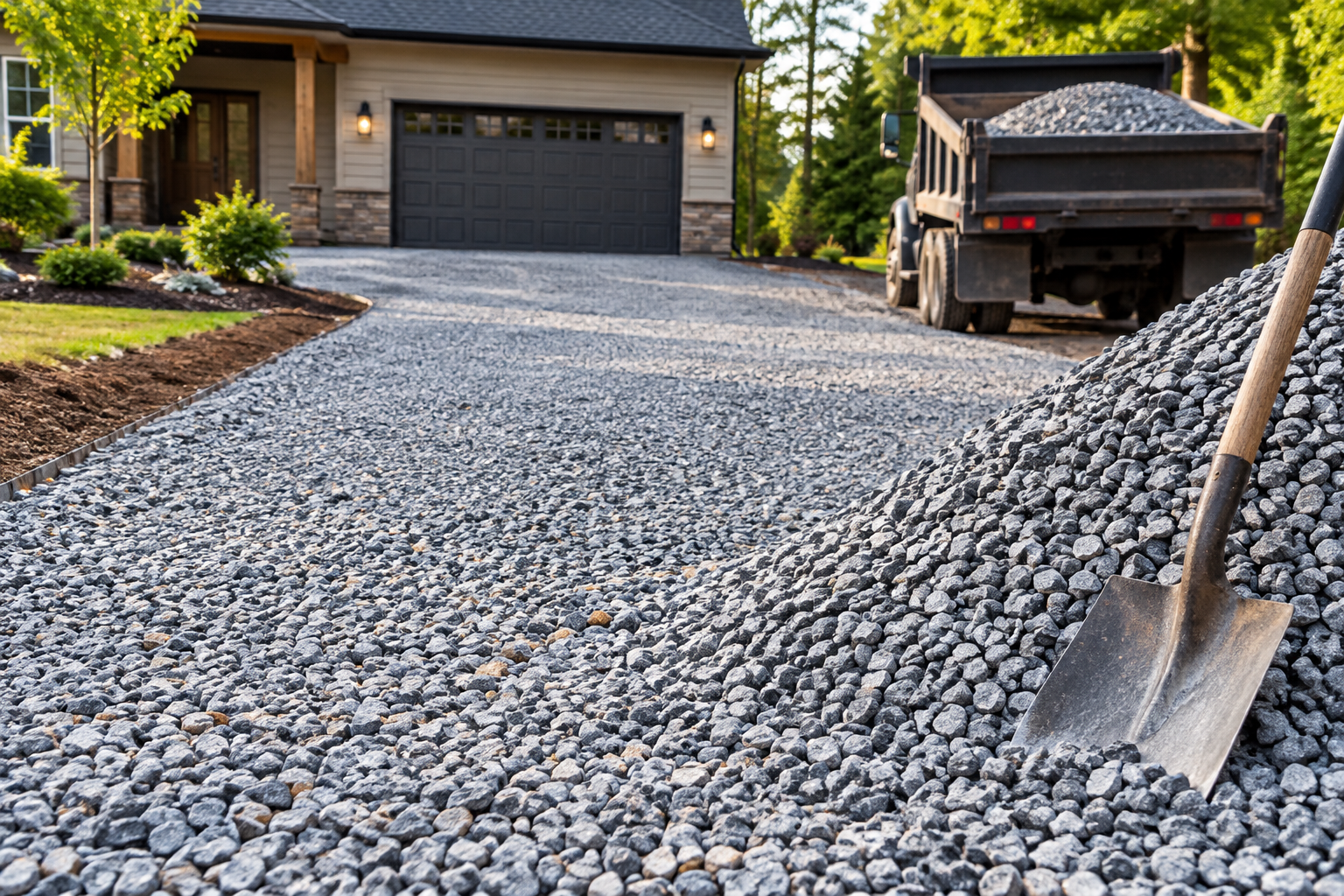
How much does it cost to put in a gravel driveway? For a typical residential project, published 2026 cost guides commonly show installed prices ranging from about $1 to $10 per square foot, depending on driveway size, gravel type, depth, site preparation, grading, drainage and local labor rates. A simple, already-prepared driveway may land near the low end, while a new driveway that needs excavation, multiple base layers, drainage work or long-distance delivery can cost much more.
If you already know your driveway dimensions, use the Gravel Driveway Calculator to estimate gravel volume and tonnage first. Then use the pricing sections below to turn the material quantity into a rough project budget.
Quick gravel driveway cost guide
| Cost item | Typical planning range |
|---|---|
| Installed gravel driveway | About $1–$10 per sq ft |
| Basic residential project | Often several hundred to several thousand dollars |
| Driveway gravel | Often tens of dollars per ton, depending on type |
| Long rural driveway | Can run into several thousand dollars or more |
| Site prep / grading / drainage | Can add substantially to the total |
Published national estimates vary because the scope is not always the same. Angi’s 2026 gravel-driveway guide reports roughly $1–$10 per square foot depending on size, gravel type and site preparation, while HomeGuide’s 2026 guide lists about $4–$10 per square foot for materials and installation. For budgeting, treat national ranges as starting points and compare them with local delivered-material prices and contractor quotes.
Gravel driveway cost per square foot
A useful first-pass estimate is to multiply driveway area by an installed cost per square foot. Current 2026 guides commonly publish ranges from roughly $1 to $3 per square foot for simpler installations, while broader full-installation estimates can reach about $4 to $10 per square foot when more site preparation, material depth or labor is included.
Estimated cost = driveway length × driveway width × installed cost per sq ft
Example: a 100 ft × 10 ft driveway has 1,000 square feet. At $2 per sq ft, that would be about $2,000. At $5 per sq ft, it would be about $5,000. The correct range depends heavily on how much preparation the site needs.
Gravel driveway installation cost by size
| Driveway size | Area | At $1–$3/sq ft | At $4–$10/sq ft |
|---|---|---|---|
| 40 × 10 ft | 400 sq ft | $400–$1,200 | $1,600–$4,000 |
| 60 × 10 ft | 600 sq ft | $600–$1,800 | $2,400–$6,000 |
| 100 × 10 ft | 1,000 sq ft | $1,000–$3,000 | $4,000–$10,000 |
| 200 × 10 ft | 2,000 sq ft | $2,000–$6,000 | $8,000–$20,000 |
| 500 × 10 ft | 5,000 sq ft | $5,000–$15,000 | $20,000–$50,000 |
These are planning examples, not contractor quotes. Long driveways can also have higher delivery, equipment and grading costs, although larger jobs sometimes achieve a lower material cost per unit.
How much does a 100 ft gravel driveway cost?
A 100-foot driveway that is 10 feet wide covers 1,000 square feet. Using the broad installed ranges above, a rough planning budget could be anywhere from around $1,000 to $10,000.
The lower end assumes favorable conditions such as an existing compacted base, easy truck access and minimal grading. The upper end is more realistic when the project needs excavation, a new aggregate base, geotextile, drainage improvements, multiple compacted layers or significant contractor labor.
Gravel driveway cost per ton
Driveway gravel is often sold by the ton. Common basic aggregates are frequently quoted around $10 to $50 per ton before or with limited local delivery, while decorative or specialty stone can cost much more. For example, Angi’s 2026 guide lists many driveway materials in roughly that basic range, with premium options such as white gravel or marble chips reaching well above it. Always compare the delivered price, not just the quarry or yard price.
Material cost alone is calculated as:
Gravel material cost = tons required × price per ton
For example, if your project needs 15 tons and your delivered gravel price is $45 per ton, the gravel itself would cost about $675 before any separate delivery, grading, compaction or labor charges.
How much gravel do you need?
Driveway cost is closely tied to material depth. A thin top-up over an existing stable driveway uses far less gravel than a new driveway built with several compacted layers.
The basic volume formula is:
Volume = length × width × depth
Because gravel is commonly purchased by the ton, you then convert volume to weight using the material density. The easiest way to do that is with the Gravel Driveway Calculator, which estimates volume, tons and material cost from driveway dimensions, depth and price.
New gravel driveway vs regraveling an existing driveway
| Project | Why the cost differs |
|---|---|
| New gravel driveway | May need clearing, excavation, grading, drainage, geotextile and multiple compacted aggregate layers |
| Regraveling / top-up | Usually adds new stone over an existing base, so less excavation and base work may be required |
| Major repair | May require reshaping, filling potholes, restoring crown and correcting drainage before new gravel is added |
This is why two driveways with the same length and width can receive very different quotes. The existing subgrade and base condition often matter as much as the amount of new gravel.
What affects gravel driveway installation cost?
- Driveway length and width: larger areas need more stone and more machine time.
- Gravel depth: thicker layers increase tonnage quickly.
- Existing ground conditions: weak, muddy or uneven soil may require more excavation and base material.
- Number of layers: a properly built driveway may use a coarse base, intermediate aggregate and a finish layer.
- Gravel type: crusher run, crushed limestone, granite, pea gravel and decorative stone have different prices.
- Delivery distance: hauling heavy aggregate can materially change the delivered price.
- Access: narrow entrances, steep slopes or restricted truck access can increase labor and equipment time.
- Grading and compaction: shaping the driveway and compacting each layer adds equipment and labor cost.
- Drainage: ditches, culverts, swales or extra grading may be needed to move water away from the driveway.
- Geotextile: fabric may be used to separate weak soil from the aggregate base and improve stability.
Gravel type and material cost
Not every gravel type performs the same way in a driveway. Angular crushed materials generally interlock and compact better than rounded stone, so a cheaper-looking material is not always the best long-term choice.
| Material | Typical use | Cost tendency |
|---|---|---|
| Crusher run / quarry process | Base or economical driveway surface | Lower |
| Crushed limestone | Base and surface applications | Low to moderate |
| Crushed granite | Durable driveway surface | Moderate |
| Pea gravel | Decorative use; less interlock | Moderate |
| River rock / premium decorative stone | Decorative top layer or edging | Higher |
Base layer vs top layer cost
A new gravel driveway is often built in layers rather than with one uniform stone size. The lower layers typically use coarser, less expensive material for strength and drainage, while the top layer may use a smaller or more attractive stone.
That means your total material budget should be calculated layer by layer. A project can have a relatively cheap top layer but still cost more overall because of the volume of base material underneath it.
Site preparation, grading and drainage costs
Site preparation is one of the biggest reasons gravel driveway quotes vary. A flat, firm site with an existing base is relatively simple. A new route through soft soil, vegetation or a slope may need clearing, excavation, grading, imported base material and drainage work before the finish gravel is installed.
Good drainage is especially important. Water flowing across or beneath the driveway can wash gravel away, create ruts and weaken the base. Paying for proper slope, crown, ditches or a culvert during installation can reduce recurring repair costs later.
DIY vs professional gravel driveway cost
DIY installation can reduce labor cost, especially for a small top-up where the existing base is already sound. However, a new driveway usually requires more than spreading stone. Excavation, correct grading, layer thickness, drainage and compaction all affect how long the driveway lasts.
Professional installation costs more upfront but may be worthwhile when the site is sloped, poorly drained, soft, long or needs heavy equipment. Compare quotes based on the full scope—base depth, gravel type, number of layers, compaction and drainage—not just the final price.
Why long driveways do not always scale at one flat rate
It is tempting to take the cost of a 50-foot driveway and simply multiply it by ten for a 500-foot driveway, but real projects do not always scale that way. Equipment mobilization and some fixed costs are spread over a larger job, while hauling distance, extra truckloads, terrain changes and drainage crossings may push the total back up.
For long rural driveways, estimate the material quantity first, then add delivery, equipment, grading and any drainage structures separately.
Gravel driveway maintenance cost
Gravel driveways usually need periodic maintenance. Typical tasks include filling potholes, restoring the crown, grading ruts, replacing gravel lost to traffic or runoff and controlling weeds at the edges.
A properly built base and good drainage can reduce how often major repairs are needed. When comparing gravel with asphalt or concrete, include this ongoing maintenance in your long-term budget rather than comparing installation price alone.
Gravel vs asphalt driveway cost
Gravel is generally cheaper to install than asphalt, particularly when the driveway is long. Asphalt gives a smoother, more finished surface but needs a well-prepared base and typically has a higher upfront cost. Gravel is easier to add to or repair but requires more frequent grading and stone replacement.
If you are comparing a future paved option, use the Asphalt Driveway Calculator to estimate asphalt tonnage and cost from the same driveway dimensions.
How to estimate your gravel driveway budget
- Measure the driveway length and width.
- Decide whether this is a new build, repair or simple gravel top-up.
- Choose the planned gravel depth and number of layers.
- Calculate cubic yards and tons with the Gravel Driveway Calculator.
- Get local delivered prices for each aggregate layer.
- Add grading, excavation, compaction and equipment costs.
- Add drainage, geotextile or culvert costs if required.
- Compare the result with at least a few local contractor quotes.
Frequently asked questions
How much does a gravel driveway cost per square foot?
Published 2026 estimates vary widely. Simpler installations are often quoted around $1 to $3 per square foot, while broader installed-cost guides can reach roughly $4 to $10 per square foot when more preparation and labor are included.
How much does a 100 ft gravel driveway cost?
A 100 ft × 10 ft driveway contains 1,000 square feet. A broad planning range is roughly $1,000 to $10,000 depending on gravel depth, existing base condition, grading, drainage, labor and local material prices.
How much does gravel cost per ton for a driveway?
Common driveway aggregates are often priced in the tens of dollars per ton before delivery, while premium stone can cost much more. Always ask for the delivered price because hauling heavy aggregate can be a major part of the final material cost.
Is it cheaper to gravel an existing driveway?
Usually, if the existing base is still stable and drainage is working. A simple top-up needs less excavation and base material than building a driveway from bare soil.
What is the biggest gravel driveway cost factor?
For many projects, the biggest cost drivers are driveway size, gravel depth and site preparation. Poor soil, steep slopes, drainage problems and long delivery distances can push the total up quickly.
Bottom line
The cost to put in a gravel driveway depends on much more than the price of stone. Size, depth, site preparation, delivery, grading, drainage and compaction all matter. Start by estimating the amount of gravel you need, then price the material and site work separately.
For a project-specific starting point, enter your driveway dimensions, compacted depth, gravel density and local price into the CalcWoven Gravel Driveway Calculator.
Cost figures in this guide are general 2026 planning ranges compiled from national cost guides. Local contractor quotes, aggregate prices and delivery charges can differ significantly.