
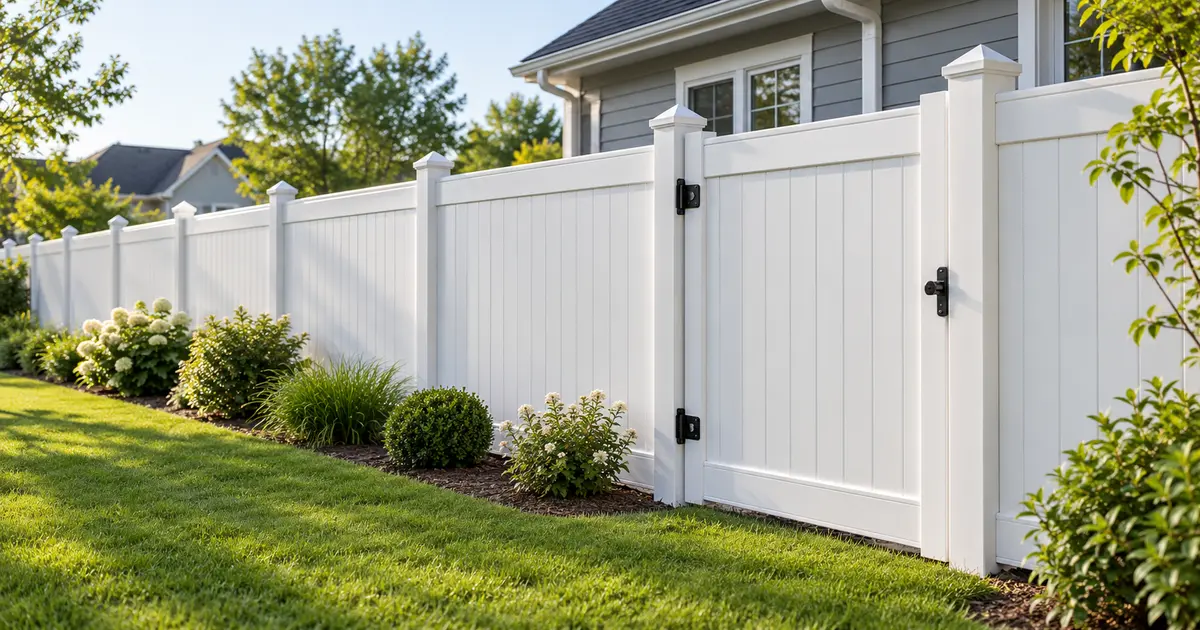
Vinyl fence installation cost is best estimated by linear foot, with gates and separately priced work identified before you compare totals. Homewyse’s May 2026 reference starts at $58.70–$82.35 per linear foot for its specified basic installation. Your quote may differ with the fence system, height, layout, location and site conditions.
A panel price from a retailer is not the price of a finished fence. To build a useful budget, measure the fence runs, select a product and height, and ask what the installer includes. The examples below show how to compare complete scopes without adding material or labor twice. All money figures are in US dollars.
How much does vinyl fence installation cost per linear foot?
Homewyse’s vinyl fence installation estimator lists a starting reference of $58.70–$82.35 per linear foot in May 2026. Its example assumes basic work under favorable conditions and can be adjusted for ZIP code, quantity and options. It is a planning reference, not a fixed local quote.
Homewyse identifies delivery, worksite preparation and setup among its inclusions, while sales tax and permit or inspection fees are excluded. Check the exact selections and notes before using the result. Do not assume another contractor’s rate includes the same tasks.
The most useful comparison is the installed price for your chosen fence system and agreed site scope. Record the product, height, measured length, gate arrangement and exclusions alongside every rate. An offer missing those details is difficult to compare even when its headline price looks attractive.
Vinyl fence cost for 100, 150, 200 and 300 feet
The following table uses assumed installed rates of $45, $60 and $80 per linear foot to demonstrate the math. These are not measured low, average and high national prices. They apply only to the length billed at that rate; separately quoted gates, removal, taxes or other exclusions must be handled according to the actual offer.
| Fence length | At $45/ft | At $60/ft | At $80/ft |
|---|---|---|---|
| 100 ft | $4,500 | $6,000 | $8,000 |
| 150 ft | $6,750 | $9,000 | $12,000 |
| 200 ft | $9,000 | $12,000 | $16,000 |
| 300 ft | $13,500 | $18,000 | $24,000 |
Preliminary budget = billed fence length × quoted installed rate + separately priced work. Replace the example rate with a written quote for your project. A minimum job charge, quantity adjustment or different site scope can prevent the final price from scaling exactly with length.
How much does a 100-foot vinyl fence cost?
At the assumed $60 installed rate, 100 feet calculates to $6,000 before confirmed extras. First establish whether “100 feet” means the entire boundary, including gate openings, or 100 feet of panel runs plus gates. Those are different quantities and can produce different totals.
How much does a 200-foot vinyl fence cost?
At the same assumed $60 rate, 200 billed feet calculates to $12,000. If that boundary includes gates, ask how they are priced before using the full 200 feet in the panel calculation. Do not subtract openings automatically if the contractor’s package already accounts for them.
How do height and style affect vinyl fence pricing?
Request a separate total for each combination you are considering. A 6-foot white privacy fence, a shorter picket fence and a post-and-rail layout are different products. Comparing the same length does not make their material lists or installation scopes equivalent.
| Option | Specification to include in a quote |
|---|---|
| Privacy or semi-privacy | Product name, height, panel design and color |
| Picket | Picket profile, spacing, finished height and matching gate |
| Post and rail | Rail configuration and any separately specified infill |
| Lattice or decorative top | Complete panel height, top detail and matching posts |
| Color or textured finish | Exact finish, product series and matching accessories |
For a 6 ft vinyl fence cost per foot comparison, keep the height and product fixed across bidders. If one price covers a different height or series, request the comparable alternative before deciding which installer is cheaper. Product photos and model numbers make this easier than descriptions such as “standard vinyl.”
For an 8-foot option or a fence intended for a particular use, confirm that the proposed system and layout are suitable and permitted at the property. A taller product should be quoted as a complete system; do not estimate it by simply increasing the price of a shorter panel by its percentage increase in height.
How much do vinyl gates add to the installation cost?
Ask for the complete installed gate assembly: gate, posts, required supports, hinges, latch and any specified locking or closing hardware. A gate-kit purchase price alone does not tell you what installation will cost. Have the contractor identify whether any of those items are already included in the fence package.
Specify the opening you need, how the gate will be used and the space available for its swing. Compare a pedestrian gate and an equipment-access double gate as separate options. Ask for the proposed clear opening and overall arrangement in writing rather than assuming the named gate size describes every dimension.
For budgeting, use a quoted amount per gate instead of multiplying its opening by a standard panel rate. For example, if a contractor separately quotes a hypothetical $900 gate assembly, use that line item under the agreed billing method. That figure is an arithmetic example, not a published gate-cost benchmark.
What should an installed vinyl fence quote include?
| Scope item | Question to resolve |
|---|---|
| Fence system | Which panels, posts, caps, connectors and color are supplied? |
| Layout | Which measured runs, corners, ends and gate openings are included? |
| Post installation | What footing and support specification applies to this system and site? |
| Labor and equipment | Which installation operations and equipment are covered? |
| Delivery | Are transport, unloading and access arrangements included? |
| Gates | Are hardware, supports and installation in the gate price? |
| Old fence | Are panels, posts, footings, hauling and disposal included? |
| Completion | Who handles cleanup, surplus material and disturbed landscaping? |
| Other charges | Are tax, approvals or allowances separate? |
Mark each item as included, excluded or an allowance. A materials worksheet can explain what the job uses, but it is not necessarily an extra invoice. If panels, concrete and labor are inside the installed rate, adding them again will overstate your budget.
What can increase the final fence installation price?
ReVamp’s installation cost guide identifies design, labor, fence length, accessories, permits and existing-fence removal as cost considerations. Use those categories to ask project-specific questions rather than attaching an unsupported allowance to every item.
Removal and disposal
Describe the existing fence and ask whether the price covers both above-ground sections and the agreed post or footing removal. Confirm hauling, disposal and any site restoration. If old concrete will remain anywhere, have the contractor explain how that affects the new layout before approving the work.
Slopes, obstacles and access
Provide photos of slopes, restricted gates, paved areas and obstacles along the route. Ask the installer to describe the proposed panel arrangement and any extra preparation. Where the ground changes, request a sketch showing how the finished fence follows the site so appearance and scope are agreed before installation.
Posts, corners and gate supports
Prepare a layout showing corners, ends and gates instead of budgeting from one total length alone. Ask which post types and supports the selected system needs. The fence post spacing guide explains layout considerations, but the chosen manufacturer’s instructions should determine the installation details.
Barrette Outdoor Living publishes separate instructions for vinyl panels, gates and mounting options. Use the instructions for the exact product, not a generic spacing or gate detail taken from a price estimator. Review the fence post depth guide for planning context, then confirm the project specification.
Approvals and project boundaries
Confirm the boundary and any relevant approval requirements before finalizing the layout. Ask who arranges the necessary checks, who pays applicable fees and what happens if the approved layout differs from the estimate. Prices in this guide do not establish a local permit exemption or a suitable location for the fence.
How to calculate your vinyl fence installation budget
1. Measure each run and identify openings
Draw the proposed layout and label each run. Identify the fence sections being replaced, gates being retained and new openings. If two contractors measure different total lengths, resolve the difference before comparing their rates. The Fence Calculator can support quantity planning once the layout and spacing assumptions are established.
2. Agree on how gates are counted
Suppose a boundary measures 150 feet from end to end and includes a 4-foot gate opening. In this hypothetical quote, the contractor bills 146 feet of panel runs and prices the gate assembly separately. That gives 150 − 4 = 146 feet for the panel calculation. This billing convention must match the written offer; it is not a universal pricing rule.
3. Add only separately quoted items
| Hypothetical budget item | Calculation | Amount |
|---|---|---|
| Installed panel runs | 146 ft × assumed $60/ft | $8,760 |
| Gate assembly | Separately quoted example | $900 |
| Old-fence removal and disposal | Separately quoted example | $600 |
| Illustrative subtotal | $8,760 + $900 + $600 | $10,260 |
| Optional homeowner reserve | 10% × $10,260 | $1,026 |
| Planning total with reserve | $10,260 + $1,026 | $11,286 |
Every rate and extra in this example is hypothetical. The reserve is money the homeowner keeps available for planning, not an automatic contractor charge. Taxes and other exclusions must follow the actual proposal. If removal or the gate is already included, remove the duplicate line instead of adding it again.
4. Keep material quantities separate from installed prices
A quantity estimate helps explain panel, post and footing needs; it does not establish an installed rate. For example, estimating concrete volume for the specified post holes with the Concrete Calculator can support a supply worksheet. It does not select the required footing dimensions or create an additional charge when concrete is already included.
Is DIY vinyl fence installation cheaper?
Compare a complete DIY materials-and-equipment budget with the professional scope. Include the selected system, gate hardware, delivery, tools or rentals, disposal and any work you will outsource. Check how many days you need rented equipment and where materials will be stored before installation.
Obtain a product-specific supply list before comparing it with a panel-only advertised price. Record which items come in the kit and which must be purchased separately. If you already own tools or can reuse suitable components, show that as a project-specific saving rather than a general saving every homeowner will receive.
Ask the manufacturer about installation requirements and applicable warranty conditions. Decide who will resolve layout changes, unexpected ground conditions or damaged parts. An apparently lower DIY purchase total may describe less work than a contractor’s completed fence proposal.
Is vinyl fencing cheaper than wood or chain link?
Get comparable quotes for the same measured layout, intended use and agreed preparation. Ask for gates, removal and completion work to be identified under each alternative. A privacy vinyl fence and an open chain-link boundary may serve different requirements even when they enclose the same area.
Keep the initial installation comparison separate from future maintenance or repair assumptions. Ask what product care is required, what the warranty covers and how matching replacement components can be obtained. Avoid declaring one material universally cheapest from rates collected for different products and locations.
Vinyl fence installation cost FAQs
Does an installed price include posts and concrete?
Check the written scope. Ask the installer to identify the supplied posts, supports, footing materials and labor. Do not add a separate post or concrete allowance to a package that already includes them.
Is a price per panel the same as a price per foot?
No. Dividing a panel’s purchase price by its stated width produces a panel-only price per foot. It does not include all posts, accessories, gates or installation. Confirm the product’s layout dimensions and complete supply requirements before estimating the project.
How much is vinyl gate installation?
Use an itemized quote for the selected gate assembly and opening. Confirm posts, required supports, hardware and installation, and whether the fence price already contains any of those items. The $900 amount in the worked example is illustrative.
Can existing fence posts be reused?
Have the installer assess compatibility with the proposed system, condition, layout and required supports. Request reuse as a clearly defined option if appropriate. Do not assume the old post positions match a new panel system simply because the boundary length is unchanged.
What is the best way to compare two installation quotes?
Compare product, height, measured runs, gates, preparation, exclusions and total price together. If one bid excludes required removal, add its quoted removal cost for comparison. Keep a homeowner reserve separate so it does not distort the contractor-to-contractor comparison.
Sources and pricing notes
Sources checked October 16, 2026: Homewyse’s May 2026 vinyl fence installation reference, ReVamp’s installation cost factors and Barrette Outdoor Living’s product instruction resources. Published prices retain their source labels. The length table and worked budget use assumed rates, not a CalcWoven national-price survey. Obtain a current written quote for the selected product and property.