
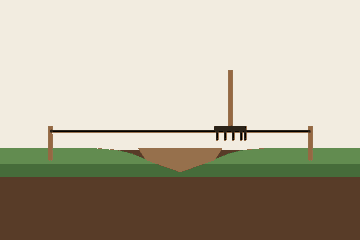
To level a lawn with dips under about an inch, mow the grass short, spread a thin layer of topdressing (soil, sand, compost or a mix) over the low spots, rake it in so the grass blades still show, water lightly, and repeat after the grass has grown through. University of Maryland Extension says about ¼ to ¾ inch of material can usually go on turf without smothering the crown, and Cornell’s sports-turf program applies ¼ inch per pass, building up to a total of ¾ to 1 inch over time. Anything deeper than that is a different job: lift the turf, fill underneath and relay it.
To work out how much soil or sand you need, use the Topsoil Calculator or the Sand Calculator, and enter the depth in inches.
First, find out why the lawn is uneven
Leveling fixes the surface, not the cause. University of Maryland Extension lists the usual culprits: ruts from mower tires or vehicles, erosion swales from roof downspouts or other water flow, and low-lying areas from uneven grading. If water is the cause, fix the drainage first or the dip will come back.
- Check the slope near buildings. University of Maryland Extension says soil should slope away from a building, ideally 1 to 2 percent, which is a drop of 1¼ to 2½ inches every 10 feet.
- Do not add soil over tree roots. University of Maryland Extension warns that minor soil depth changes over roots can contribute to tree decline. If shallow roots are a trip hazard or in the way of the mower, it suggests a groundcover or mulch instead.
- Look for compaction or buried debris under hard lumps before you fill over them.
How deep is the dip? Pick the right method
| Depth of the dip | What to do | Basis |
|---|---|---|
| Up to about ¾ inch | Topdress in one or two thin passes | University of Maryland Extension: ¼ to ¾ inch on turf without smothering the crown |
| About ¾ to 1 inch | Several thin passes of ¼ to ½ inch, waiting for the grass to grow through each one | Cornell: ¼ inch per pass, building to ¾ to 1 inch in total over time |
| More than about 1 inch | Lift the turf, fill with topsoil underneath, firm it and relay the turf (or reseed bare spots) | Common practice. Extension limits on how much material turf tolerates top out near 1 inch |
| Large areas, bad grading or drainage | Regrade, and replant using new-lawn preparation | University of Maryland Extension: regrade to level mounds and ruts, using good topsoil to fill low points |
Extension sources give depth limits for how much material grass tolerates. An Ask Extension expert advises a ½-inch topdressing rather than a 3-inch layer when you cannot till. The lift-and-relay method for deeper holes is standard practice among lawn-care professionals, but we did not find an extension page that sets an exact depth for switching to it.
University of Wisconsin Extension agrees on the thin-layer rule. It describes topdressing as a thin layer of soil, usually no more than ¼ to ½ inch, and warns that at least half of the leaf height should stay visible, or the turfgrass may be killed by lack of sunlight. It also says large dips or swales can be corrected by adding soil to the area with a shovel.
What to use to fill low spots
- Topsoil or a topsoil-compost mix: University of Maryland Extension names topsoil or compost for filling shallow ruts. Topsoil adds structure and nutrients, so it suits deeper low spots.
- Sand: Cornell’s turf program lists sand as a way to level minor depressions, using angular or medium-coarse sand. Industry guides add that pure sand works best where your soil is already sandy.
- Compost: Cornell says compost should be mature, screened, fine and tested, and applied at no more than ¼ inch per pass.
- A mix: lawn-care companies often recommend roughly equal parts sand, compost and topsoil, or 70 percent sand with 30 percent topsoil or compost. Lawn-care guides advise matching the mix to the soil you already have, so ask your local extension office.
Use screened, weed-free material with no stones. For weights, see how much does a yard of topsoil weigh and how much does a yard of sand weigh.
How to level a lawn step by step
- Mow short, but do not scalp. A lower cut shows the low spots and lets the mix reach the soil.
- Mark the low spots. Lay a straight board or a string line across the area, or look after rain to see where water sits.
- Mix the topdressing in a wheelbarrow until it is even.
- Place small piles in and around each low spot.
- Spread it thinly. Pull the mix across the dip with the back of a rake, a leveling rake or a push broom, working from different directions. Aim for ¼ to ½ inch at a time, so the grass blades still poke through.
- Water lightly to settle it, without washing it out of the dip.
- Wait for the grass to grow through, usually a few weeks, then repeat in another thin layer if the spot is still low.
- Seed any bare patches once the surface is level. See how to overseed a lawn.
When to level a lawn
Do it while the grass is actively growing, so it can grow up through the new layer. NC State Extension says cool-season grasses grow most actively in spring and fall, while warm-season grasses grow best in summer. That points to spring or early fall for cool-season lawns and late spring to summer for warm-season lawns. Avoid frozen, drought-stressed or dormant turf, which cannot grow through the soil. If you plan to reseed, the usual seeding windows are in when to plant grass seed.
How much soil or sand do you need?
Volume in cubic yards = area (sq ft) × depth (in) ÷ 324. Use the area you are actually topdressing, not the whole lawn, unless you are covering it all.
| Area topdressed | ¼ inch deep | ½ inch deep | Topsoil at ½ inch (1.10 tons/yd³) | Dry sand at ½ inch (1.35 tons/yd³) |
|---|---|---|---|---|
| 100 sq ft | 0.08 yd³ (2.1 ft³) | 0.15 yd³ (4.2 ft³) | 0.17 tons | 0.21 tons |
| 500 sq ft | 0.39 yd³ (10.4 ft³) | 0.77 yd³ (20.8 ft³) | 0.85 tons | 1.04 tons |
| 1,000 sq ft | 0.77 yd³ (20.8 ft³) | 1.54 yd³ (41.7 ft³) | 1.70 tons | 2.08 tons |
| 5,000 sq ft | 3.86 yd³ (104.2 ft³) | 7.72 yd³ (208.3 ft³) | 8.49 tons | 10.42 tons |
Weights use CalcWoven’s planning values for topsoil and dry sand. Real material varies with moisture and supplier.
Worked examples
- Five 3 × 3 ft dips filled ½ inch deep: 45 sq ft × 0.5 ÷ 12 = 1.9 cubic feet, or 0.07 cubic yards. That is less than one wheelbarrow load (a standard wheelbarrow holds about 3 cubic feet).
- Topdressing a whole 2,000 sq ft lawn ¼ inch deep: 2,000 × 0.25 ÷ 324 = 1.54 cubic yards, about 1.70 tons of topsoil.
- A 10 × 10 ft area leveled with sand, ½ inch deep: 100 × 0.5 ÷ 324 = 0.15 cubic yards, about 0.21 tons of dry sand.
Soil settles after you spread it, so topdressing a little proud of the surrounding grass is common. Add the optional waste allowance in the calculators if you want a margin.
Fixing ruts and deep holes
University of Maryland Extension says shallow ruts can be filled without replanting if only a small adjustment is needed (about ¼ to ¾ inch of topsoil or compost). For substantial ruts, erosion swales or low-lying areas, it says they need to be fixed. For bare areas, its advice is to rake away dead grass so seed or sod makes direct contact with the soil, level the uneven ground, and use the same soil preparation and planting methods as for a new lawn. See sod vs seed to choose how to cover the repaired area.
For a deep hole in good grass, the usual method is to cut and fold back the turf, fill underneath with topsoil in layers, firm it, then lay the turf back and water it in. Keep the repaired surface level with, or just proud of, the lawn around it.
Common mistakes
- Adding too much at once, which smothers the grass.
- Burying the grass blades completely so they cannot get light.
- Leveling while the grass is dormant, frozen or drought-stressed.
- Using a mix very different from your existing soil, or unscreened material full of stones and weed seeds.
- Not fixing drainage, so the dip returns.
- Washing the mix out with a strong spray.
- Adding soil over tree roots.
Common questions
How much topdressing can I put on a lawn at once?
About ¼ to ½ inch at a time. University of Maryland Extension gives ¼ to ¾ inch as the most that goes on turf without smothering the crown, and Cornell applies ¼ inch per pass.
Can I level a lawn with just sand?
For minor dips, yes, as Cornell notes for sports turf, using angular or medium-coarse sand. Industry guides add that sand alone works best where your soil is already sandy. Otherwise a soil-sand-compost mix is the common choice.
What is the best time of year to level a lawn?
When the grass is actively growing: spring or early fall for cool-season grasses, and late spring to summer for warm-season grasses.
Do I need to remove the grass first?
Not for dips under about an inch. Topdress over the grass and let it grow through. For deeper holes, lift the turf, fill and relay it.
How much soil do I need to level my lawn?
Area in square feet × depth in inches ÷ 324 = cubic yards. For 1,000 sq ft at ½ inch, that is about 1.5 cubic yards.
Should I roll my lawn to level it?
Thin topdressing is the standard fix for dips, and rolling does not add the missing soil. A lightweight roller is used on new sod to improve soil contact, as in how to lay sod.
Bottom line
Fill dips with no more than ¼ to ½ inch of soil, sand or a mix at a time, rake it in so the grass shows through, and repeat as it grows. For deeper holes, lift and relay the turf. Work out the volume with the Topsoil Calculator or the Sand Calculator, and see how much topsoil do I need for more depth tables.
Soil conditions, grass types and drainage vary. For serious grading or drainage problems, consult a landscape professional or your local extension office.
Sources
Extension numbers on depth come from University of Maryland Extension, Cornell and University of Wisconsin Extension (Lawn Aeration and Topdressing, A3710). The step-by-step method, the lift-and-relay approach and the mix ratios reflect lawn-care industry practice, which is why they are described as common practice.
- University of Maryland Extension: Improving a Struggling Lawn and Repairing Damage
- University of Maryland Extension: Starting a New Lawn
- Cornell Turfgrass Program, Safe Sports Fields: Topdressing
- Ask Extension: tilling vs topdressing
- NC State Extension Gardener Handbook: Lawns
- LawnStarter: How to Level a Yard (industry practice)